


A Frozen shoulder is also referred to as adhesive capsulitis and is characterized by stiffness and pain in the shoulder joint. The shoulder is made up of three bones that form a ball-and-socket joint. The bones, ligaments, and tendons make up the shoulder joint and are encased in a capsule of connective tissue. When the capsule thickens and tightens around the shoulder joint, it results in a frozen joint. As a result, the movement of the shoulder is restricted
Who is at risk of getting a Frozen shoulder?
Adhesive capsulitis occurs four times more in females than in men. In addition, people diagnosed with diabetes or suffering from high blood pressure or thyroid disease including people with
- Shoulder injury
- Parkinson disease
- Cancer
- Complex regional pain syndrome
- Stroke
Complications of a Frozen shoulder
- Residual pain
- Residual stiffness
- Fracture of the humerus
- Rupture of the biceps tendon after shoulder manipulation
Staging
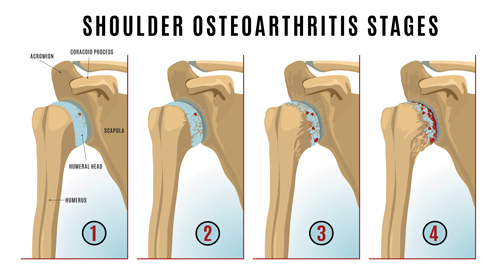
Frozen shoulder progress gradually in three overlapping stages
- Painful/ Freezing stage (1 &2)
- Frozen/Adhesive stage (3)
- Thawing Stage (4)
-
Painful/Freezing stage
At this stage, the shoulder becomes more painful and it begins to feel duller. The pain is worse at night with increased joint restriction. This occurs over six to nine weeks and the shoulder slowly loses range of motion
-
Frozen/ Adhesive stage
This is the second stage after the freezing stage, the pain starts to ease though the stiffness remains. The stage lasts for four to six months. The frozen stage is difficult since there are limited movements and impaired function making daily activities difficult.
-
Thawing / Recovery stage
This is the last stage, the pain begins to settle and movement gradually improves. Inward rotation of the arm comes last.
Diagnosis for Frozen Shoulder
Clinical diagnosis is made by medical history, physical examination, and imaging. There is no specific test alone that provides a definitive confirmation of a frozen shoulder. A shoulder X-Ray identifies osteoarthritis and a Shoulder ultrasound looks for any rotator cuff tears that cause pain and stiffness.
Consultation
- Physical therapy
- Pain specialist
- Orthopedic surgeon
Treatment
The majority of treatment options for a frozen shoulder are non-operative and include pharmacological management and physical therapy.
-
Physiotherapy

Physiotherapists provide exercises to promote strength and movement.
-
Steroid injections
Steroid injections are used for decreasing inflammation as a result, the pain decreases. However, they should be used in moderation considering the side effects.
-
Hydro-dilatation
Large volume of fluid is used to dilate or expand the joint. Steroid, local anesthetic, and saline are injected directly into the shoulder under ultrasound guidance to produce the dilation where the capsule is stiff.
Surgical treatment
Surgical treatments are done when non-surgical options fail
-
Manipulation under anesthesia (MUA)
A general anesthesia is given to loosen the shoulder joint.
-
Arthroscopic capsular release

It focuses on arthroscopic surgery, two small incisions are made around the shoulder and a camera and a probe are inserted. The fluid is then injected to cause the dilation to decrease stiffness. The procedure limits further damage to the shoulder joint.
Enhancing outcomes
The management of frozen shoulder is done by a team of healthcare professionals that include the orthopedic surgeon, a rehabilitation specialist, a practitioner, a pharmacist, and a pain consultant. Patients managed with corticosteroids need monitoring for adverse side effects, however, enrolling in physiotherapy is the key to recovery


